String theory
1. Overview
String theory is a theoretical framework in physics proposing that the fundamental constituents of the universe are not point-like particles but extremely small one-dimensional vibrating strings. The different vibrational modes of these strings correspond to the different particles observed in nature.
The theory aims to unify all fundamental forces of nature into a single consistent framework, often referred to as a Theory of Everything (TOE). It attempts to reconcile two pillars of modern physics that are currently incompatible:
- Quantum Mechanics — governing particles and microscopic interactions
- General Relativity — governing gravity and large-scale spacetime structure
String theory suggests that spacetime itself may have additional dimensions beyond the familiar three spatial dimensions and one time dimension, typically predicting 10 or 11 dimensions depending on the model.
Although still unconfirmed experimentally, string theory has produced deep insights across theoretical physics, mathematics, cosmology, and quantum information.
It seeks to answer questions such as:
- What is the fundamental structure of matter?
- Can gravity be unified with quantum mechanics?
- Does spacetime contain hidden dimensions?
- Is there a single theory describing all physical laws?
Whether or not string theory ultimately proves correct, it has already transformed modern theoretical physics and continues to drive research at the frontiers of science.
2. Knowledge map of string theory
STRING THEORY
|
+--- FOUNDATIONS
|    |
|    +--- quantum mechanics
|    +--- general relativity
|    +--- quantum field theory
|    +--- mathematical physics
|
+--- BASIC CONCEPTS
|    |
|    +--- vibrating strings
|    +--- open strings
|    +--- closed strings
|    +--- string tension
|
+--- DIMENSIONS
|    |
|    +--- extra spatial dimensions
|    +--- compactification
|    +--- Calabi-Yau manifolds
|     |
|     |    +--- shapes of extra dimensions
|     |    +--- determine particle physics
|     |
|     +--- MODULI SPACES
|     |    |
|     |    +--- space of possible Calabi-Yau shapes
|     |    +--- determines possible universes
|     |
|     +--- RIEMANN SURFACES
|          |
|          +--- geometry of string worldsheets
|          +--- used to compute string interactions
|
+--- PARTICLES FROM STRINGS
|    |
|    +--- fermions
|    +--- bosons
|    +--- graviton
|
+--- SUPERSTRING THEORIES
|    |
|    +--- Type I
|    +--- Type IIA
|    +--- Type IIB
|    +--- heterotic SO(32)
|    +--- heterotic E8×E8
|
+--- M THEORY
|    |
|    +--- 11 dimensional spacetime
|    +--- branes
|    +--- dualities
|
+--- MATHEMATICAL STRUCTURES
|    |
|    +--- differential geometry
|    +--- topology
|    +--- algebraic geometry
|
+--- APPLICATIONS
|    |
|    +--- quantum gravity
|    +--- black hole physics
|    +--- cosmology
|    +--- holographic principle
|
+--- RELATED THEORIES
     |
     +--- loop quantum gravity
     +--- quantum field theory
     +--- quantum cosmology
3. Historical origins of string theory
Early particle physics (1960s)
String theory originated as a model to explain strong nuclear interactions in particle physics. In 1968, Gabriele Veneziano discovered a mathematical formula describing particle scattering that hinted at an underlying string-like structure. However, the theory initially lost popularity when quantum chromodynamics (QCD) successfully explained the strong force.
Emergence of quantum gravity (1970s)
In the early 1970s, researchers realized that string theory naturally contained a particle with the properties expected of the graviton, the hypothetical quantum carrier of gravity. This discovery transformed string theory from a model of nuclear forces into a potential theory of quantum gravity.
Superstring revolution (1984)
A major breakthrough occurred when Michael Green and John Schwarz demonstrated that certain anomalies cancel in a type of string theory known as superstring theory. This event sparked the First Superstring Revolution.
M-theory (1995)
In the mid-1990s, physicists discovered that five different versions of string theory were actually related and could be unified into a higher-dimensional framework known as M-theory. This development became known as the Second Superstring Revolution.
4. Fundamental ideas in string theory
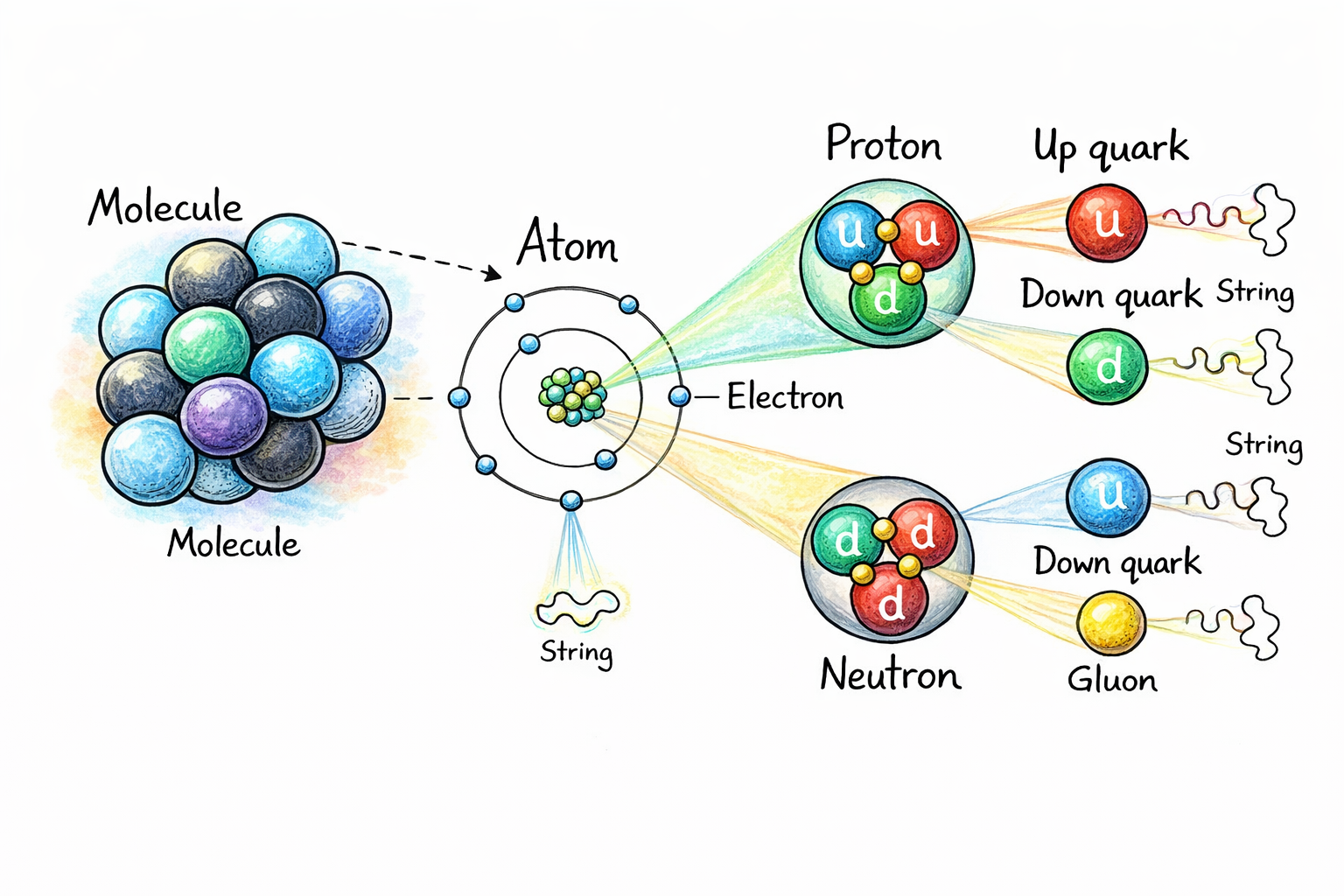
Strings instead of particles
In standard physics, elementary particles are treated as dimensionless points. String theory proposes that particles are actually tiny vibrating strings.
Different vibrations correspond to different particles:
| Vibration mode | Particle example |
|---|---|
| specific vibration | electron |
| another vibration | photon |
| another vibration | quark |
Extra dimensions
String theory predicts additional spatial dimensions beyond the three we observe. Typical models require:
- 10 dimensions (superstring theory)
- 11 dimensions (M-theory)
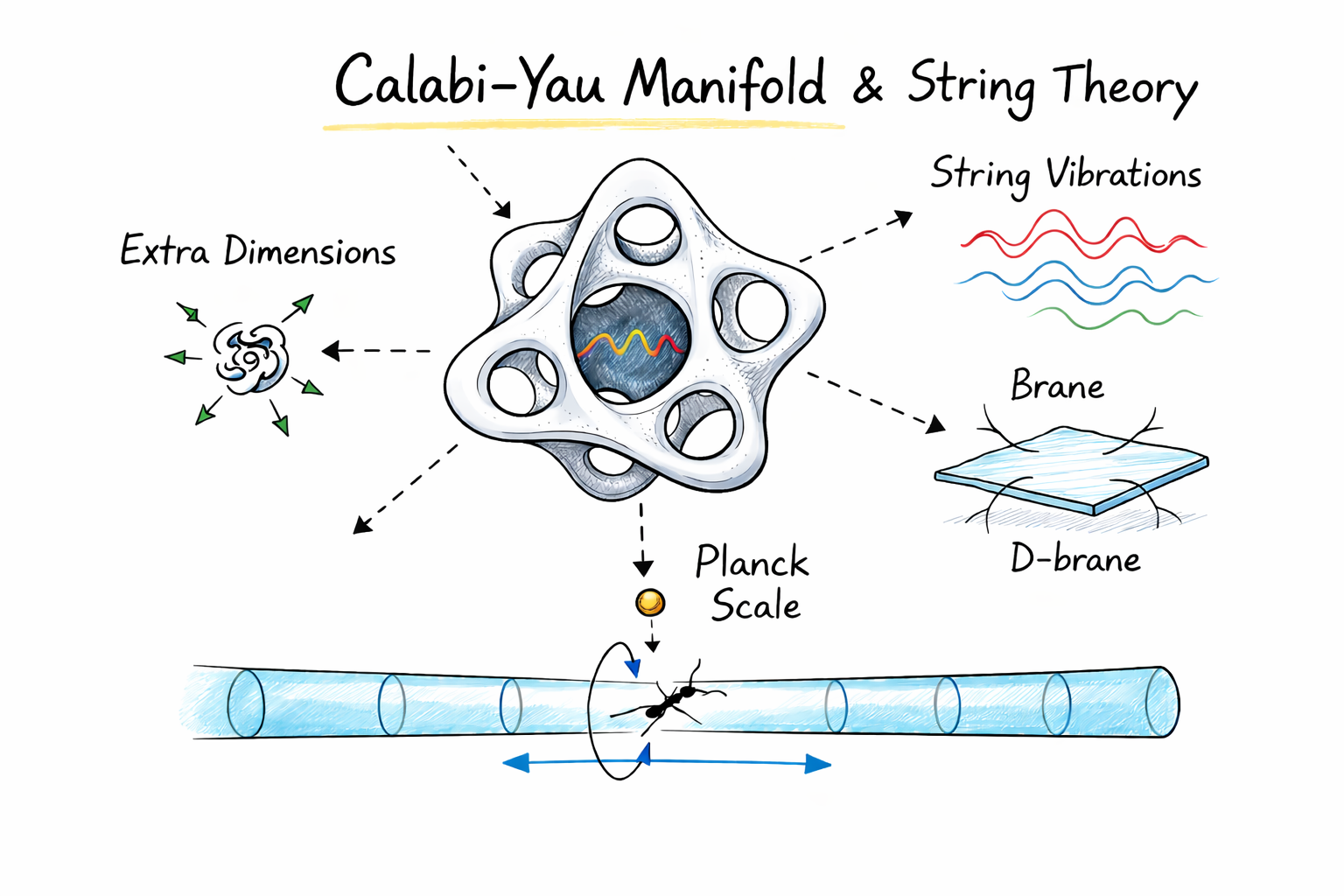
These extra dimensions are thought to be compactified into extremely small shapes called Calabi–Yau manifolds.
Supersymmetry
Many string theories incorporate supersymmetry, a symmetry linking two types of particles:
- fermions (matter particles)
- bosons (force carriers)
Supersymmetry predicts new particles, many of which are being searched for in particle accelerators.
Branes
In addition to strings, higher-dimensional objects called branes exist. Examples include:
- 1-dimensional strings
- 2-dimensional membranes
- higher dimensional “p-branes”
Branes can host entire universes in some cosmological models.
Key notes (summary)
-
From particles to strings
Unlike classical physics which describes particles as zero-dimensional points, String Theory posits that fundamental entities are tiny vibrating strings—one-dimensional objects whose different vibrational modes correspond to different particles. Electrons, photons, and quarks are no longer distinct objects but manifestations of the same fundamental string vibrating in unique patterns.
-
Extra dimensions
To remain mathematically consistent, String Theory demands more than the 4 dimensions (3 space + 1 time) we experience. It suggests that the universe has 10 or even 11 dimensions with the extra dimensions compactified into complex geometrical structures called Calabi–Yau manifolds that are too small to observe directly.
-
The brane world
String Theory also introduces branes—higher-dimensional analogs of strings. Our entire universe could be a 3-dimensional brane embedded in a higher-dimensional space, meaning that while particles are stuck on this brane, gravity might leak into extra dimensions. This might explain why gravity is so weak compared to other forces.
-
Quantum gravity & the graviton
One of the most promising aspects of String Theory is that it naturally incorporates gravity. A particular vibration mode of a closed string behaves exactly like the hypothetical graviton—the quantum particle of gravity. This provides a long-sought route to a quantum theory of gravity, resolving inconsistencies between General Relativity and Quantum Mechanics.
-
Five theories → one M-theory
In the 1990s, physicists discovered that the five seemingly different string theories were actually aspects of one deeper theory, known as M-theory. This theory includes superstrings, membranes (branes), and 11 dimensions, and is still being explored.
5. Major versions of string theory
There are five consistent versions of superstring theory.
| Theory | Characteristics |
|---|---|
| Type I | open and closed strings |
| Type IIA | non-chiral theory |
| Type IIB | chiral theory |
| Heterotic SO(32) | unified gauge symmetries |
| Heterotic E8×E8 | candidate for grand unification |
These theories are believed to be connected through M-theory.
6. Mathematical foundations
String theory relies heavily on advanced mathematics. Key tools include:
- differential geometry
- topology
- group theory
- complex manifolds
- algebraic geometry
Important mathematical objects include:
- Calabi–Yau manifolds
- moduli spaces
- Riemann surfaces
| Concept | What it describes | Role in string theory |
|---|---|---|
| Calabi–Yau manifolds | shape of hidden dimensions | determines particle physics |
| Moduli spaces | space of all possible geometries | determines possible universes |
| Riemann surfaces | surfaces traced by strings | used to calculate interactions |
These three mathematical objects — Calabi–Yau manifolds, moduli spaces, and Riemann surfaces — play fundamental roles in string theory and modern theoretical physics.
7. Calabi–Yau manifolds
Basic idea
A Calabi–Yau manifold is a special type of geometric space used in string theory to describe the extra hidden spatial dimensions of the universe. String theory requires 10 dimensions (superstring theory) or 11 dimensions (M-theory), but we observe 4 (3 space + 1 time). The additional spatial dimensions are compactified into tiny geometric shapes called Calabi–Yau manifolds.
Intuition
Imagine a garden hose. From far away it looks like a 1-dimensional line, but up close you see a circular cross section. Similarly, the universe appears 3-dimensional, but at extremely small scales extra dimensions could be curled up inside Calabi–Yau shapes.
Properties of Calabi–Yau manifolds
They are defined by several mathematical properties:
- Complex manifold
- Ricci-flat geometry
- Preserves supersymmetry
These properties make them compatible with string theory equations.
Why they matter in physics
The shape of the Calabi–Yau manifold determines physical properties of the universe, such as:
- particle masses
- number of particle families
- interaction strengths
In some models, the geometry helps explain why we have three generations of particles.
Visualization
Calabi–Yau manifolds are extremely complex 6-dimensional shapes. Common illustrations show them as intricate folded geometries resembling twisted flowers or curled multidimensional shapes.
Questions physicists ask
- Which Calabi–Yau shape corresponds to our universe?
- How many possible Calabi–Yau geometries exist?
- Can we detect signatures of extra dimensions?
8. Moduli spaces
Basic idea
A moduli space is the mathematical space that describes all possible shapes or configurations of a system. Instead of studying a single object, moduli spaces study the entire family of possible objects.
Simple example
Imagine a triangle. You can change side lengths and angles. Each possible triangle represents a point in a space of all triangles. That collection of possibilities forms a moduli space.
In string theory
In string theory, moduli spaces describe all possible shapes of extra dimensions. Each point in the moduli space corresponds to a different Calabi–Yau geometry and, potentially, a different physical universe. This motivates the idea of the string landscape.
Physical importance
Moduli spaces determine:
- particle masses
- coupling constants
- vacuum energy
- fundamental constants
Understanding moduli stabilization is a major challenge in string theory.
Questions physicists ask
- Why does our universe choose one point in moduli space?
- What determines the values of fundamental constants?
- Are there multiple stable universes?
9. Riemann surfaces
Basic idea
A Riemann surface is a geometric surface used to describe complex-valued functions and string worldsheet dynamics. They are two-dimensional curved surfaces.
Examples include:
- sphere
- torus (donut shape)
- multi-holed surfaces
Intuition
When a string moves through spacetime, it traces out a two-dimensional surface called the worldsheet. This worldsheet behaves mathematically like a Riemann surface, so studying string interactions becomes equivalent to studying the geometry of Riemann surfaces.
Examples of Riemann surfaces
| Surface | Example |
|---|---|
| Sphere | closed string propagation |
| Torus | one-loop quantum corrections |
| Higher-genus surfaces | complex string interactions |
The number of holes in the surface corresponds to interaction complexity.
Why they matter
Riemann surfaces allow physicists to compute:
- string scattering amplitudes
- quantum corrections
- topology of string interactions
They are central to conformal field theory, which underlies string theory.
Questions physicists ask
- How do string interactions correspond to surfaces?
- How does topology affect physical predictions?
10. String theory and gravity
One of the most important features of string theory is that gravity emerges naturally from the theory. A specific vibration of the string behaves like the graviton, the quantum particle responsible for gravity. This makes string theory a promising candidate for quantum gravity.
11. String theory and black holes
String theory has made major contributions to black hole physics. Key achievements include:
- explaining black hole entropy
- modeling microscopic states of black holes
- understanding holographic dualities
These results help connect quantum mechanics with gravity.
12. AdS/CFT correspondence
One of the most influential ideas from string theory is the AdS/CFT correspondence, proposed by Juan Maldacena (1997).
This principle suggests that:
- gravity in higher-dimensional spacetime
- quantum field theory in lower dimensions
are mathematically equivalent.
This duality has influenced fields such as:
- quantum gravity
- condensed matter physics
- quantum information
13. Observational status
String theory currently lacks direct experimental confirmation.
Challenges include:
- extremely small string scale (near Planck length)
- energies far beyond current accelerators
- vast landscape of possible solutions
However, research continues through:
- cosmology
- black hole physics
- mathematical consistency tests
14. Ongoing and planned research programs
Large Hadron Collider (CERN)
Physicists search for indirect evidence of supersymmetry and extra dimensions.
Cosmological observations
Early universe observations may provide clues to:
- extra dimensions
- brane cosmology
- inflation models
Quantum gravity research
Institutions studying string theory include:
- Institute for Advanced Study
- Perimeter Institute
- CERN
- Kavli Institute for Theoretical Physics
15. Important research papers
- Green & Schwarz (1984): Anomaly Cancellation in Supersymmetric Gauge Theory
- Maldacena (1997): The Large N Limit of Superconformal Field Theories and Supergravity
- Polchinski (1995): Dirichlet Branes and Ramond–Ramond Charges
16. Bookshelf
Introductory
- Brian Greene — The Elegant Universe
- Leonard Susskind — The Cosmic Landscape
- Barton Zwiebach — A First Course in String Theory
Intermediate
- Joseph Polchinski — String Theory Vol. 1 and 2
Advanced
- Green, Schwarz & Witten — Superstring Theory
17. Learning resources
- Perimeter Institute lectures
- CERN theoretical physics seminars
- MIT OpenCourseWare string theory
- An Introduction to String Theory (Steuard Jensen)
- Stanford theoretical physics lectures