Blackholes
Overview
A black hole is a region of spacetime where gravity is so strong that nothing—not even light—can escape once it crosses a boundary known as the event horizon. Black holes are among the most extreme objects in the universe and play a central role in astrophysics, cosmology, and theoretical physics.
They are predicted by Einstein’s general relativity and arise when a large amount of mass collapses into an extremely compact region. Observations over the past decades—from gravitational waves to direct imaging—have confirmed that black holes are real astrophysical objects.
Black holes help physicists explore fundamental questions:
- How does gravity behave at extreme scales?
- What happens to information falling into a black hole?
- How do galaxies form and evolve?
- Can gravity and quantum mechanics be unified?
Black holes represent one of the most profound frontiers of science.
They challenge our understanding of:
- gravity
- quantum mechanics
- spacetime
- information
By studying black holes, physicists hope to uncover a deeper theory that unifies the laws governing the universe.
Knowledge map of black hole physics
BLACK HOLES
|
+--- FORMATION
|    +--- stellar collapse
|    +--- early universe formation
|
+--- STRUCTURE
|    +--- event horizon
|    +--- singularity
|    +--- accretion disk
|    +--- relativistic jets
|
+--- TYPES
|    +--- stellar
|    +--- intermediate
|    +--- supermassive
|    +--- primordial
|
+--- OBSERVATIONS
|    +--- gravitational waves
|    +--- telescope imaging
|    +--- X-ray astronomy
|
+--- THEORETICAL QUESTIONS
     +--- information paradox
     +--- quantum gravity
     +--- Hawking radiation
Historical origins of black hole discovery
Early concept (18th century)
The first theoretical idea resembling a black hole came from:
- John Michell (1783)
- Pierre-Simon Laplace
They proposed “dark stars”—objects whose escape velocity exceeded the speed of light. At the time, light was thought to behave like particles, so the idea was largely speculative.
Einstein’s general relativity (1915)
Black holes emerged naturally from general relativity, Einstein’s theory of gravity. The equations showed that spacetime could curve so strongly that light could not escape.
Soon after, Karl Schwarzschild (1916) discovered an exact mathematical solution describing such an object. This solution introduced:
- Schwarzschild radius
- event horizon
Collapse theory (1930s)
Physicists realized massive stars could collapse under gravity. Important work:
- Subrahmanyan Chandrasekhar
- Robert Oppenheimer
- Hartland Snyder
They showed that sufficiently massive stars could collapse into objects with no known mechanism to stop them.
The term “black hole”
The term black hole was popularized in 1967 by physicist John Wheeler. Before that they were called:
- gravitationally collapsed objects
- frozen stars
Structure of a black hole
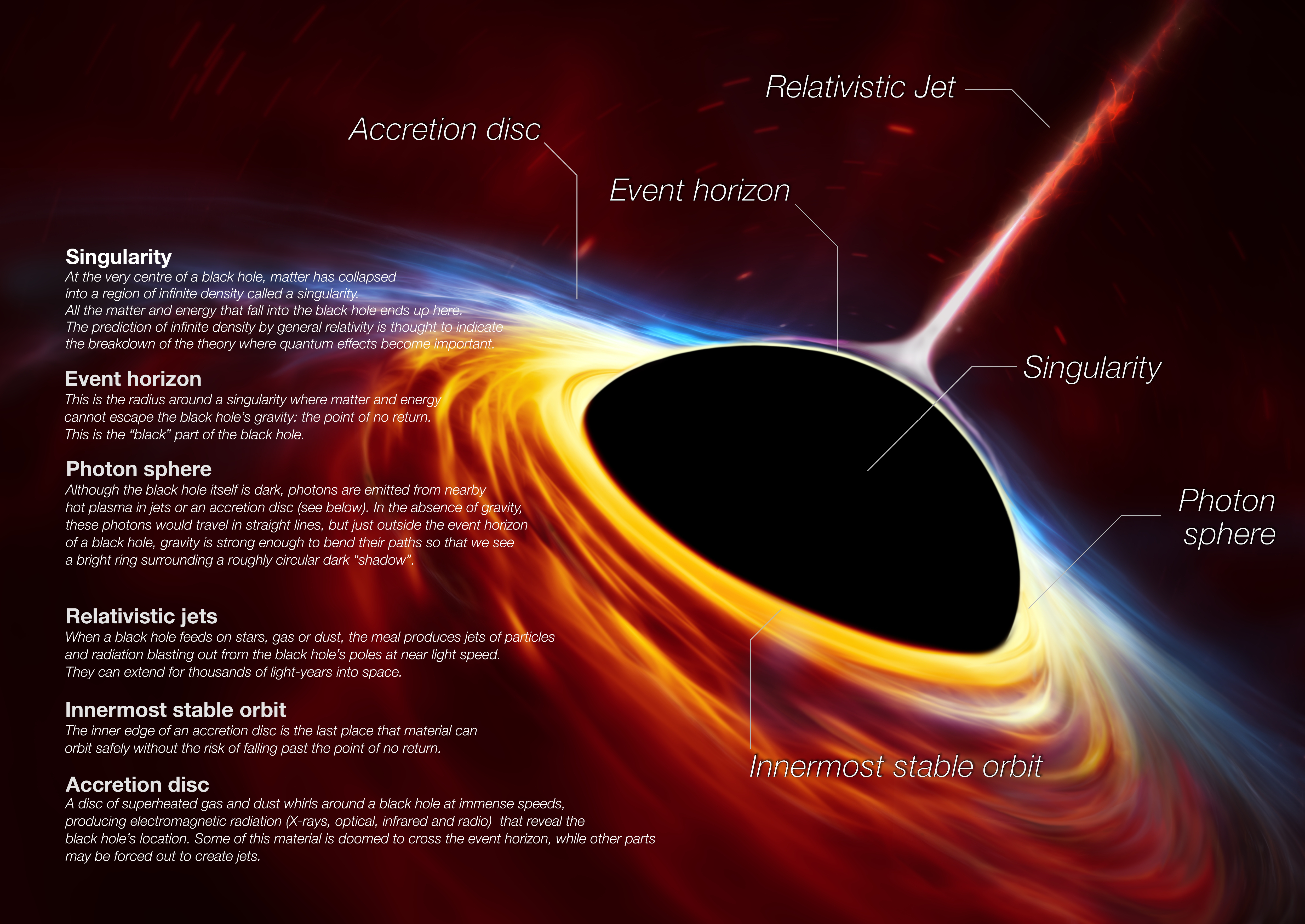
Black holes contain several key regions.
Event horizon
The event horizon is the boundary where escape becomes impossible. Once crossed, nothing can return.
Questions to ask
- What information is lost beyond the horizon?
- Can information escape through quantum effects?
Singularity
At the center lies a singularity, where density becomes infinite and classical physics breaks down. Here:
- spacetime curvature becomes infinite
- general relativity no longer applies
This is one reason physicists seek a quantum theory of gravity.
Accretion disk
Matter falling into a black hole forms a hot rotating disk. These disks can emit enormous energy, making black holes visible indirectly.
Examples:
- quasars
- active galactic nuclei
Jets
Some black holes produce relativistic jets. These jets can extend thousands of light-years. They are powered by magnetic fields and rotational energy.
Types of black holes
Stellar black holes
Mass: 5–100 solar masses
Formation: collapse of massive stars after supernova explosions.
Example: Cygnus X-1
Supermassive black holes
Mass: millions to billions of solar masses.
Location: centers of galaxies.
Example: Sagittarius A* (center of the Milky Way)
Role: influence galaxy formation and evolution.
Intermediate black holes
Mass: 100–100,000 solar masses.
Evidence is still emerging. Possible formation mechanisms:
- star cluster collapse
- black hole mergers
Primordial black holes
Hypothetical black holes formed in the early universe shortly after the Big Bang. They could potentially explain part of dark matter.
Major discoveries about black holes
Hawking radiation (1974)
Stephen Hawking discovered that black holes can emit radiation due to quantum effects near the event horizon.
Implication: Black holes may evaporate over time.
Questions
- Does information escape during evaporation?
- What happens at the end of a black hole’s life?
Information paradox
The black hole information paradox arises because:
- quantum mechanics says information cannot be destroyed
- black holes seem to destroy information
This paradox remains one of the biggest puzzles in physics.
Black hole thermodynamics
Black holes behave like thermodynamic systems.
They possess:
- temperature
- entropy
- energy
The Bekenstein–Hawking entropy relates black hole entropy to surface area.
Observational evidence for black holes
X-ray binaries
When a black hole pulls material from a companion star, the gas heats and emits X-rays. Example: Cygnus X-1
Stellar orbits around Sagittarius A*
Astronomers tracked stars orbiting the Milky Way’s center. Their motion revealed a supermassive black hole of about 4 million solar masses.
Gravitational waves
In 2015, the LIGO observatory detected gravitational waves from merging black holes. This confirmed a major prediction of general relativity.
Direct imaging
In 2019, the Event Horizon Telescope produced the first image of a black hole (M87*). In 2022, it imaged Sagittarius A*. These images show the shadow of the event horizon.
Recent advancements
Recent progress has dramatically improved black hole research.
Event Horizon Telescope improvements
New telescopes and algorithms are improving imaging resolution. Goals include:
- time-resolved images
- movies of black hole environments
Gravitational wave astronomy
Advanced detectors (LIGO, Virgo, KAGRA) are discovering many black hole mergers. This field enables:
- measuring black hole masses
- studying strong gravity
Simulations and AI
Supercomputer simulations model:
- accretion disks
- jet formation
- black hole mergers
Machine learning helps analyze massive astrophysical datasets.
Ongoing and planned projects
Several major international projects focus on black hole research.
Event Horizon Telescope (EHT)
A global network of radio telescopes forming an Earth-sized interferometer. Goal: imaging event horizons. Future improvements include space-based telescopes.
LIGO and Virgo
Laser interferometers detecting gravitational waves. They study:
- black hole mergers
- neutron star collisions
LISA (Laser Interferometer Space Antenna)
Planned space-based gravitational wave detector. Launch target: 2030s. It will detect:
- supermassive black hole mergers
- early universe signals
Square Kilometre Array (SKA)
The largest radio telescope ever built. Applications:
- studying black hole jets
- mapping galactic centers
Athena X-ray Observatory
ESA mission planned for the 2030s. Goal: observe black hole accretion disks.
Black holes and fundamental physics
Black holes are laboratories for extreme physics. They connect several fields:
| Field | Connection |
|---|---|
| General Relativity | gravitational collapse |
| Quantum Mechanics | Hawking radiation |
| Cosmology | early universe physics |
| String Theory | holographic dualities |
One of the most important ideas is the holographic principle, suggesting that information inside a volume of space can be encoded on its boundary.
Key research papers
- Schwarzschild (1916): On the Gravitational Field of a Mass Point
- Hawking (1974): Black Hole Explosions
- Bekenstein (1973): Black Hole Entropy
- Abbott et al. (2016): Observation of Gravitational Waves from a Binary Black Hole Merger
Bookshelf
Beginner to advanced:
- Stephen Hawking — A Brief History of Time
- Kip Thorne — Black Holes and Time Warps
- Brian Greene — The Elegant Universe
- Leonard Susskind — The Black Hole War
- Carlo Rovelli — Black Holes: The Edge of All We Know
Learning resources
- Event Horizon Telescope website
- NASA Astrophysics portal
- CERN theoretical physics lectures
- Perimeter Institute public lectures
- MIT OpenCourseWare astrophysics